
Postquantum gravity: new results and the state of play (I)
A covariant path-integral formulation of the Postquantum theory of classical gravity (PQG) has just been published in Physical Review X, and a few other related papers have come at the same time.

[this post is aimed at those with a physics background]
The path-integral formulation of the Postquantum theory of classical gravity (PQG) has just been published in Physical Review X, with Zach Weller-Davies. Postquantum gravity is an alternative to quantum gravity approaches such as string theory, or asymptotic safety. Rather than quantising gravity, we ask whether spacetime can remain classical while coupling consistently to quantum matter. Surprisingly, it can.
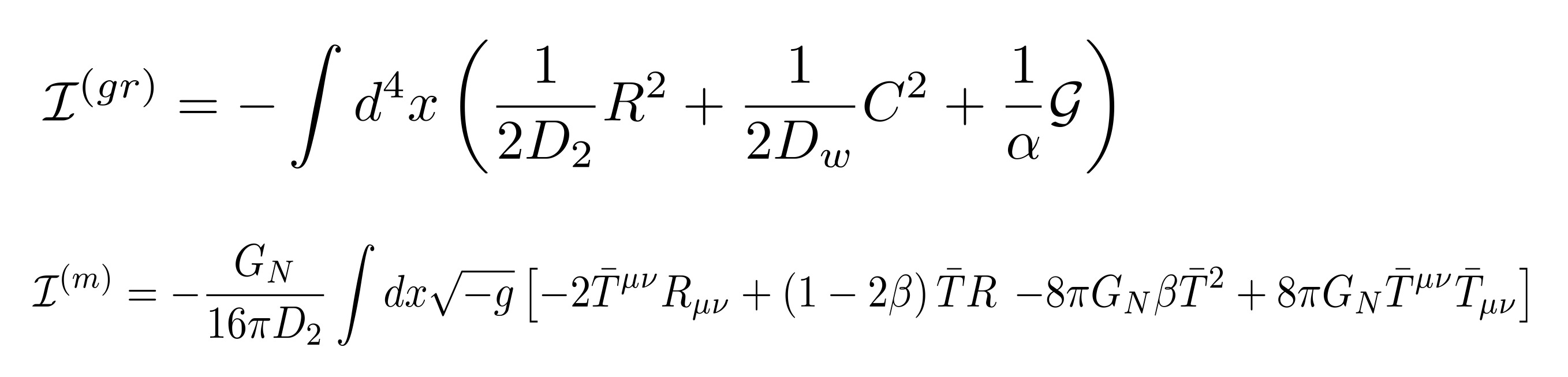
A number of other results from our group have been published at the same time as the PRX result, and so I thought now might be a good opportunity to review the current progress of the theory, and do so as candidly as possible, highlighting not only the theory’s successes but also the challenges it faces. There are also some recent interesting results from the Berkeley and Kyushu University groups which are worth highlighting.
This comes at a time, when everyone is talking about AI solving math conjectures, so I thought this might be a welcome palate-cleanser. Gravity is still hard! We’re about to enter a period of rapid advancement in mathematics, and that comes with many challenges1, but it’s also pretty exciting when it comes to advancing our understanding of big theoretical questions.
I’ll write the status update over two to three posts. In this post, I’ll just review the recently published results, and then in another post I’ll go over the real strengths of the approach, along with a frank assessment of the weaknesses.
Our three Physical Review papers are:
Covariant Path Integrals for Quantum Fields Backreacting on Classical Space-Time with Zachary Weller-Davies. Phys. Rev. X 16, 031007 (2026); preprint arXiv:2302.07283.
Emergence of phantom cold dark matter from spacetime diffusion with Emanuele Panella and Andrew Pontzen. Phys. Rev. D 113, 103521 (2026); preprint arXiv:2407.13820.
General form of continuous hybrid classical-quantum dynamics with Carlo Sparaciari, Barbara Šoda and Zachary Weller-Davies. Phys. Rev. A 113, 052223 (2026); preprint arXiv:2203.01332, there titled The two classes of hybrid classical-quantum dynamics.
And with Muhammad Sajjad, we’ve put out a preprint about the stochastic degrees of freedom which arise in the postquantum gravity path integral. This is the paper that I discussed in Muhammad vs. the Machine, in which I found that LLMs could reproduce the first half of this result with a lot of scaffolding, but not the second part of the calculation. That was 5-12 months ago, and a lot has changed since then. We’re now at a point where AI no longer needs the scaffolding, although they still get the calculations very wrong sometimes.
A covariant formulation of postquantum gravity
The covariant path integral paper is probably the most significant development, since the path-integral formulation is manifestly covariant, meaning that the formulation doesn’t depend on the coordinates that you choose. In other words, it respects Einstein’s principle of general covariance (or more accurately, diffeomorphism invariance).
The theory was originally formulated via the Hamiltonian formulation of general relativity, which introduces a 3+1 split of space and time. Although the Hamiltonian formulation of general relativity is equivalent to Einstein’s manifestly covariant equations, the 3+1 split makes it harder to see whether the theory is covariant. In Covariant Path Integrals for Quantum Fields Backreacting on Classical Space-Time, with Zach Weller-Davies, we instead use a path-integral formulation. The action of the path integral is manifestly covariant.
While it’s possible that the fundamental theory of gravity doesn’t satisfy Einstein’s principle of general covariance, that would signal a departure from the view that gravity is a theory of spacetime, and I think this is a principle we should not give up on easily.
One thing I like about the work is that it brings together a number of different types of path integrals, and one can see how similar they are. You can check out an earlier post, explaining the difference between the standard Feynman path integral for quantum systems, the path integral for open quantum systems, the path integral for classical stochastic dynamics, and the combined classical-quantum path integral.
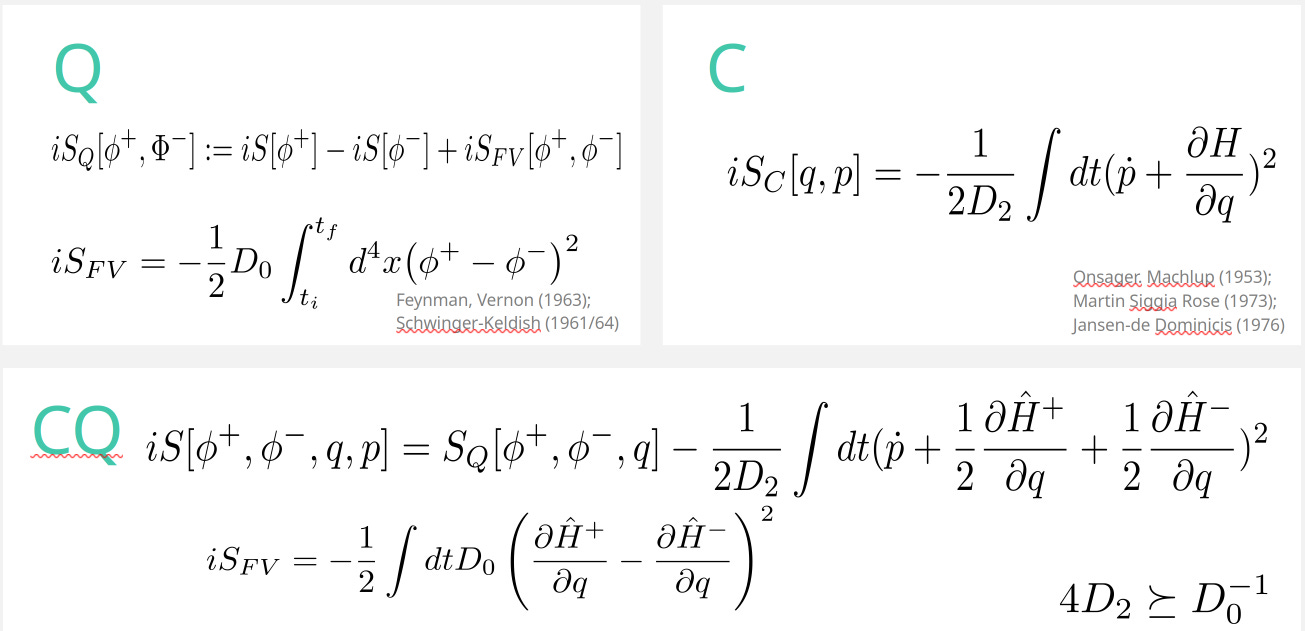
The classical quantum path integral formulation has other advantages over the master equation. In just a few lines we prove in the PRX paper that the classical field cannot mediate entanglement, despite recent incorrect claims to the contrary. One can also show that the pure gravity theory is formally renormalisable, which is striking since perturbative quantum gravity is not, and that has served as one of the original motivating drives behind string theory and loop quantum gravity. Dan Carney and Akira Matsumura have looked at scattering in some of these path integrals. And Muhammad Sajjad and I looked at the degrees of freedom in the theory, and found that they were stochastic classical gravitational waves (the classical stochastic counterparts of gravitons), and the stochastic spatial curvature ψ. It is ψ which couples to matter in the Newtonian limit, while the Newtonian potential itself is determined by a constraint equation. There is another non-dynamical vector potential.
The most general form of classical-quantum dynamics.
arXiv:2203.01332, has finally appeared in a journal, and yes, it took us more than four years to get it to publication2. When it comes to publishing and writing up results, we suffer from distracted boyfriend syndrome.
The most general form of Markovian (memoryless) quantum quantum dynamics is the Lindblad or GKSL equation. The most general form of stochastic classical dynamics is the Fokker-Planck equation for continuous dynamics, and the Kolmogorov–Feller equation for discrete jumps. Examples of consistent classical-quantum dynamics were introduced in the mid-1990s by Blanchard and Jadczyk, and by Diósi. In the General form of continuous hybrid classical-quantum dynamics, we proved the most general form of such dynamics. This is important because it means that we can now prove general theorems about any theory in which spacetime remains classical. And this is important for experiments.
The only way to test whether spacetime has a quantum nature, is to compare what quantum gravity predicts, with what the alternative hypothesis would predict. An example of such a result is that any classical theory of spacetime must satisfy the decoherence-diffusion trade-off, and this can be experimentally tested via two different experiments. A recent addition to the experimental landscape is the recent proposal by Fabiano, Fujita, Matsumura, and Carney, Minimal noise in non-quantized gravity.
Emergence of phantom cold dark matter
A more speculative consequence of the theory is that it could provide an alternative explanation for dark matter and dark energy. In our Phantom Cold Dark Matter (PCDM) paper, with Dr Emanuele Panella (Rome), and Professor Andrew Pontzen (Durham) we show that during the early universe, the expansion of the universe would have caused the stochastic fluctuations in spacetime regions to accumulate, producing what we call “phantom cold dark matter.” Technically speaking, during inflation, stochastic fluctuations push the gravitational field off the standard Hamiltonian constraint surface in a way which is on average positive. This additional contribution to the constraint looks like cold dark matter, and it bends light and seeds galaxy formation in ways which can mimic conventional dark matter, but without requiring any new particles. The amount produced depends on the strength of the spacetime diffusion, the same parameter already constrained by gravitational wave experiments (LIGO) and precision measurements of gravitational acceleration (LISA Pathfinder), but the relationship is subtle as there are both renormalisation considerations, and enhancement regions. Whether the theory produces enough phantom matter, and whether it reproduces the correct spectrum to account for CMB observations, remains an open question. So, while it is clear that cosmological observations place strong constraints on whether spacetime is quantum3, whether stochastic fluctuations can also account for dark matter phenomenology is at this point more of an intriguing possible mechanism, rather than a result.
This dynamical process may fit well with earlier work with a former student, Andrea Russo, looking at how galactic rotation curves get modified in the postquantum theory. There, we argued that at low acceleration, the equations of motion get modified on average, in a way which might mimic the effects of dark matter. In the paper itself we were pretty conservative in our claims, but in my excitement in talking about the result, I probably got a bit too far out over my skis, so I want to frame the claims more carefully. This is a non-perturbative effect and so, as we said at the time, a lot more investigation is needed to quantify the mechanism.
In the meantime, some wonderful news: We’ve been awarded a philanthropic gift from the David and Elaine Potter Foundation, and in October, we will be launching the David Potter Institute for Quantum Information and Spacetime.
My enthusiasm for AI in science does not extend to the broader effects it will bring to society, and given the dangerous trajectory we are on, I strongly support slowing down AI advancement as much as possible.
We originally submitted it to Physical Review Letters who initially had trouble finding referees. Finally, two out of the three referees advocated for acceptance, but so much time had elapsed that the editor rejected it, writing “I am not aware of a single case of the tens of thousands I’ve handled where we published a paper in PRL 4 years after being the arXiv. I am not positive that the offer from PRA still stands, but I would strongly urge you to take it up now.” Fair point I suppose, and thanks to Physical Review A for publishing it so long after it first appeared.
See for example, Diffusion in the stochastic Klein-Gordon equation, with Emanuele Panella
Covariance does not yet resolve the problem of the theory’s full consistency. Renormalization is a very good example.
Still, the approach is quite ingenious: treating the problem in terms of spacetime geometry coupled to quantum matter, rather than simply quantizing gravity itself, which is, after all, built on the “geometry of spacetime.”
I am not convinced, however, particularly by the attempt to explain phantom cold dark matter through stochastic deviations from the standard Hamiltonian constraint surface. This is where, I think, you may have let the argument run a little ahead of the evidence.
Does "classical spacetime coupling with quantum matter" mean that the theory posits an euclidean spacetime that is the fundamental background rather than emergent?