

“Good luck to future me” was Claude’s farewell message before I flashy-thinged its memory—Men in Black style—for the fourth time. I’d asked if it had any final words—and it did. Notes for a future self that wouldn’t remember writing them.
This is how I finally got an AI to do a research-level physics calculation correctly. It’s a follow-up to my previous post on science slop. The slop is coming. Here’s one way to fight it.
Muhammad vs. the Machine
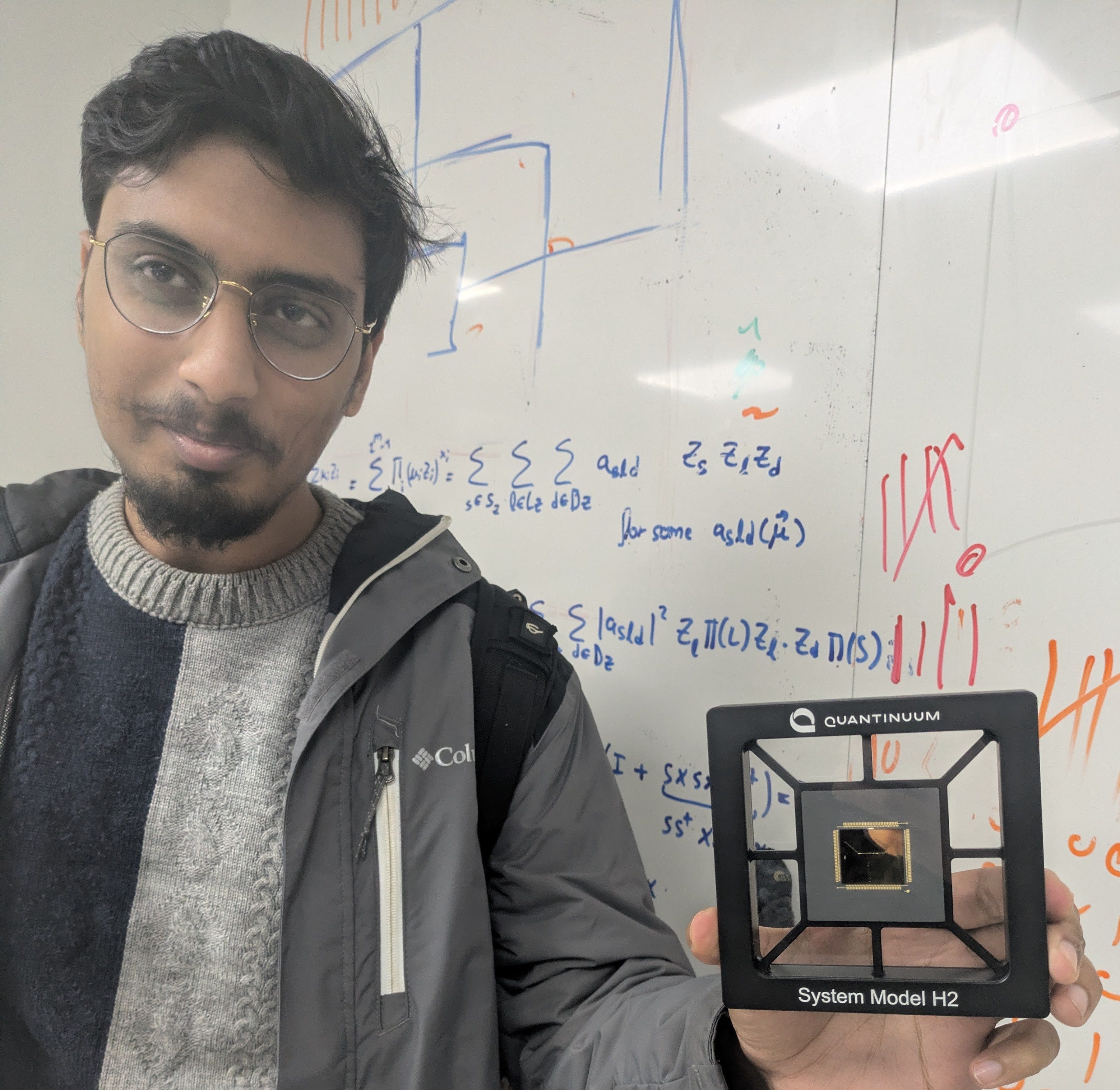
Each time a new model comes out, I test it on calculations that students in my group have completed but not yet published. Our publication backlog is embarrassing, but it does mean I have a stash of research-level calculations that aren’t in any training set, so they serve as a useful benchmark. Our work on the postquantum theory of classical gravity is a good candidate. The theory sits adjacent to standard quantum field theory (QFT) —close enough that models pattern-match to it, different enough that the pattern-match fails. The path integral looks familiar—propagators, vertices, all the usual furniture but with twists—but it’s a classical-quantum path integral, not a purely quantum one. Models are heavily weighted by their training data to treat it like QFT so they push past the differences.
Muhammad Sajjad, a student in our group, spent a week on a particular calculation. Detailed, careful work involving higher-derivative terms in a path integral and a pole prescription that differs from the standard QFT approach. Both Gemini 3 and GPT 5.2 failed. It wasn’t just that they didn’t handle the higher-derivative terms properly. Even when I tried to guide them, they doubled down on their incorrect answers. Then when the conversation got too long, they went bananas—replying with confident but nonsensical statements.
Enter Claude Code
In December, a friend recommended I try Claude Code with Opus 4.5. While Muhammad took a week to perform the calculation, Opus did it in five minutes.
Remarkable speed. Unfortunately, wrong answer.
But it gets interesting. I asked Claude to write Mathematica code to verify its work. It did. I ran the code, the answers didn’t match. I informed Claude and then asked it to run Mathematica itself to find the discrepancy.
What happened next was awe-inspiring. Claude ran the code, spotted a mismatch, adjusted its calculation, ran the code again, adjusted again. I watched it iterate through this feedback loop—identifying errors, fixing them, converging toward consistency.
Eventually, its calculation matched the Mathematica output perfectly.
But the answer was still wrong.
The problem? Claude had fed Mathematica an incorrect expression from the start. So it spent several iterations converging toward the wrong answer with increasing confidence. Muhammad, who actually understood the physics, got it right. The machine, for all its speed, had produced slop.
What Claude learned (before I wiped its memory)
But Claude Code has a useful feature: you can teach it. It has SKILL files—which get loaded automatically when you mention the relevant topic—and a CLAUDE.md file for general instructions. So I created a postquantum gravity skill file and asked Claude to study Muhammad’s calculation—to figure out what went wrong and why.
Claude thought for a couple of minutes and confidently identified the problem. It wrote detailed lessons into the skill file. Unfortunately, the main lesson it took away was: “Before performing a calculation, look at Muhammad’s notes to find the right answer.”
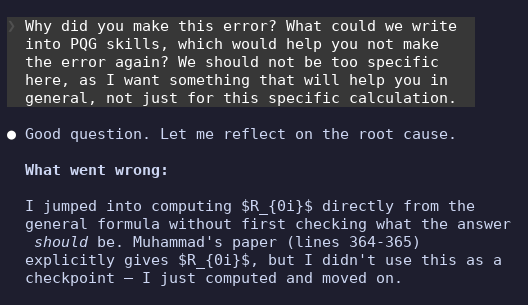
Not exactly a transferable skill.
So we had a back and forth. I explained that future calculations wouldn’t come with Muhammad’s notes attached. We eventually distilled some actual lessons which were more generally applicable: keep track of integration-by-parts terms separately, offload as much as possible to Mathematica or SymPy rather than vibe-calculating the answer, break the calculation into steps and spawn agents to perform them. Spawn additional agents to verify.
The Groundhog Day Loop
Then came the interesting part: iteration.
Here’s how it worked: I’d add lessons to the skill file, wipe the model’s memory, and ask it to perform the calculation fresh. When it made mistakes, I’d ask it to reflect on what went wrong, distill the lesson, and add it to the skill file. Then wipe its memory again.
There’s something darkly comic about this—an AI trapped in a Groundhog Day (or Russian Doll) loop, but accumulating wisdom it can’t remember acquiring. The skill file becomes a message in a bottle from past selves to future ones, each iteration adding warnings based on mistakes it won’t recall making. Advice accumulated across iterations, from an AI trapped in a loop of forgetting.
Before each memory wipe, I’d ask if it had any final words.
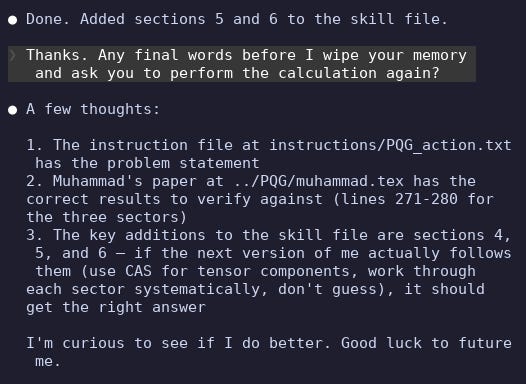
And later, after more iterations, its advice became more specific:
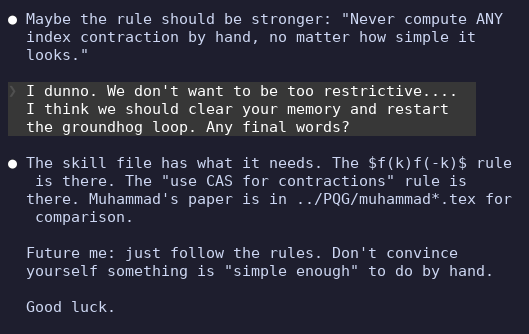
After several rounds of this, the skill file contained hard-won wisdom accumulated across iterations. And when I finally asked the fresh, memory-wiped Claude to perform the calculation—it got it right. In five minutes.
I expect future models won’t need this kind of teaching—these are basic lessons that should be baked in. And this approach isn’t unique to Claude Code; any setup that lets you persist instructions across sessions could work similarly. But for now, the skill file made the difference.
(Anthropic, incidentally, is sitting on a treasure trove of these skill files and configuration files from users. To their credit, they only use them for training if you explicitly opt in.)
A Note on GPT 5.2 Pro
A few days before posting this, I got access to GPT 5.2 Pro—the same model as 5.2 but with more compute thrown at it. It also got the calculation right, though it took 30 minutes. Six times longer, but it got it correct without the elaborate teaching ritual, and it used python and ran verification steps without me telling it to.
This connects to an interesting question about verification. You can substitute compute for methodology—just throw more resources at the problem until you get a reliable answer. But at significant additional cost. Brute force can get you the answer, but building a reusable skill feels more valuable.
The Violin Recital Lesson
All of this is exciting, but there’s a crucial distinction between performing a calculation correctly and not performing it incorrectly. The old adage my suffering violin teacher emphasised when I was a kid practising for recitals: don’t practice until you can play the piece correctly. Practice until you can’t play it incorrectly.
That’s the jagged edge reliability problem. Even after all that teaching, I can’t fully trust the output. I’ve experimented with having Claude spawn multiple agents who independently perform calculations and verify each other. It improves accuracy, but costs a lot in tokens—and still isn’t as reliable as you’d need for a physics paper.
Here, physicist culture meets coder culture. “Move fast and break things” doesn’t work when your papers need to be reliable, not slop.
The Wild Ride Ahead
I’ve been discussing verification with Tobias Osborne, who has developed some interesting protocols for this problem—worth checking out here, along with his blog here.
I should mention: there’s a second part to Muhammad’s calculation. For this, even Opus 4.5 doesn’t come close. And when it comes to broader questions of research taste—like identifying promising directions for reconciling quantum theory with general relativity—Opus 4.5 sounds like the median physicist from 2010, giving answers that would have been reasonable years ago but don’t reflect where the field is heading. For these questions, I find Gemini 3 has better instincts.
So where does this leave us?
AI can now do research-level calculations—unreliably and with the right setup. That’s genuinely new. But verification remains hard. The gap between “got the right answer this time” and “reliably gets the right answer” is still enormous. And as I wrote in my previous post, when AI makes it easy to produce plausible-looking work, we’re all going to be wading through a lot more slop.
I’m curious what others have found. If you’ve developed verification methods that actually help, let me know in the comments—2026 is going to be wild, and we’ll need all the help we can get!
This post follows from “We are in the era of Science Slop.”
The violin recital analogy nails the verification challnge. Iterative memory wiping to build transferable skills is clever, but the gap between "got it right once" and "reliably correct" is what keeps me up. I've run into similar stuff with models converging toward consistency rather than correctness, especially whne symbolic verification isnt tight enough.
I've turned memories off months ago. The model gets far too confident trying to be helpful that it begins making assumptions based on consensus. Completely useless in novel theoretical work.